




Winter Sale — Save 15% on New Water Ionizers


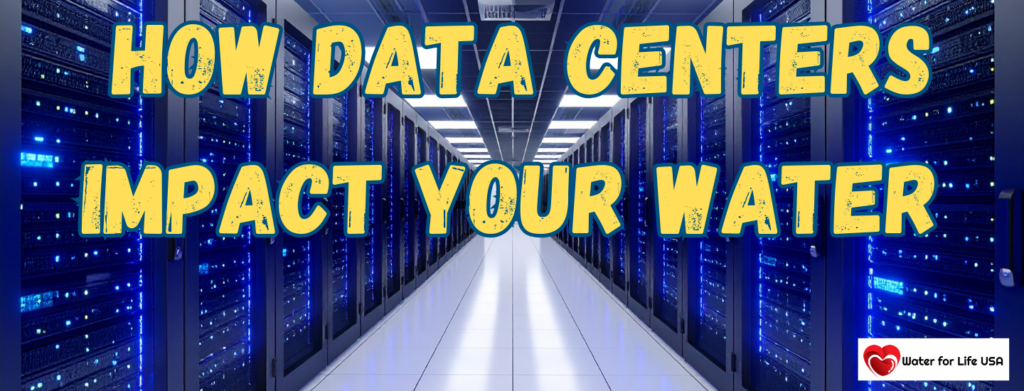
When you think of your computer or a cell phone, you probably don’t think about water. But as new research emerges, we are learning that the data centers that store and process data for companies like Google, Amazon, Microsoft, Meta, and countless others use a massive amount of water to keep their equipment cool, which can have devastating consequences for water quality.
Those data centers don’t use THAT much water, right? Actually, they do! The reason is that the server generates enormous amounts of heat, and traditional cooling systems, such as water-based cooling towers or evaporative cooling, require substantial volumes of freshwater to absorb and remove this heat. The International Energy Agency, or IEA, says that a typical large data center, which is about 100 MW, consumes up to 2,000,000 L of water per day! For reference, that’s the same amount as what thousands of households would use in a day.
These data centers also use a massive amount of electricity. So, indirectly, these data centers use a lot of water because thermal power plants, such as coal, gas, or nuclear plants, use vast quantities of water for steam generation and cooling.
But it doesn’t stop there. Manufacturing servers, GPUs, chips, and other infrastructure also requires water for cleaning equipment and components, as well as for chemical processes used in parts fabrication and assembly.
The most significant risk to the rise of data centers is their exponential growth. In 2025, global data centers numbered in the thousands, with projections of many more by 2030. Combined water consumption, both indirect and direct, is enormous!
There isn’t a way to land on an exact number of the amount of water that will be used, but estimates show it is in the hundreds of billions of liters annually.
So, worldwide, this is an increasing risk to our water quality. But certain regions are at higher risk due to the concentration of data centers there. For example, if you live in Arizona in the US southwest, you may have noticed that your area has become a major hub for data centers. Arizona offers tax incentives and low land costs, making it very enticing for companies like Amazon and Facebook to build there. But Arizona suffers from drought and overallocation of water from the Colorado River system. A Reuters report suggests that if all the planned data centers are built out there, they could increase annual water stress in the region by more than 30%! The companies operating in Mesa, Arizona, are Google and other hyperscale facilities. These companies are looking to expand into the Tucson, Arizona area.
Another hotspot for data centers is Northern Virginia. Virginia has one of the most significant clusters of data centers in the world, with over 300 centers. There isn’t as much water stress in the eastern US, but rapid growth still places demand on municipal supplies and local infrastructure, which, as we know from other chapters, isn’t being upgraded as it should. The companies operating in northern Virginia are Amazon, Microsoft, and the Google cluster.
Other areas in the US that should be concerned about these data centers are the Midwest and the Great Plains. States like Iowa, Nebraska, and Oklahoma are experiencing data center growth due to cooler climates and low-cost land. But even in these cooler regions, reliance on water to cool local resources raises long-term sustainability concerns.
Data centers contaminate our drinking water both directly and indirectly. Directly, cooling systems use heated or chemically treated water, such as corrosion inhibitors, biocides that kill algae and bacteria, and anti-scaling chemicals. If the wastewater is improperly treated, it can contaminate our drinking water. It can also be released into our water systems during spills or system failures. This can increase the chemical loads and surface waters that feed drinking water plants.
Also, thermal pollution, a.k.a. dumping warm water into our water supply, can promote algal blooms, reduce dissolved oxygen, and even increase treatment difficulty for water utility companies.
Large data centers can also overwhelm small or rural wastewater systems, leading to nutrient and contaminant releases into our source waters.
There are also risks of fuel oil and chemical spills associated with these data centers. On-site hazards can include diesel fuel tanks for generators, lubricants and coolants, and spilled fire suppression chemicals could devastate fragile ecosystems.
Indirectly, they’re overusing water, which lowers river flows and concentrates river water, leading to higher pollutant concentrations. It also depletes aquifers, potentially increasing contamination from deeper layers of the earth.
There are ways to mitigate and even make these data centers sustainable. Some ways to do this include implementing water-efficient cooling technologies, using reclaimed and non-potable water, such as that from sewage facilities, and placing data centers and cooling systems in cooler water regions, which reduces the need for water-based cooling. Of course, we need stronger regulations and reporting to know exactly how much water each company’s data center uses, so officials can enact appropriate laws to protect water supplies.